Learning From The Tengu
Sep 24, 2019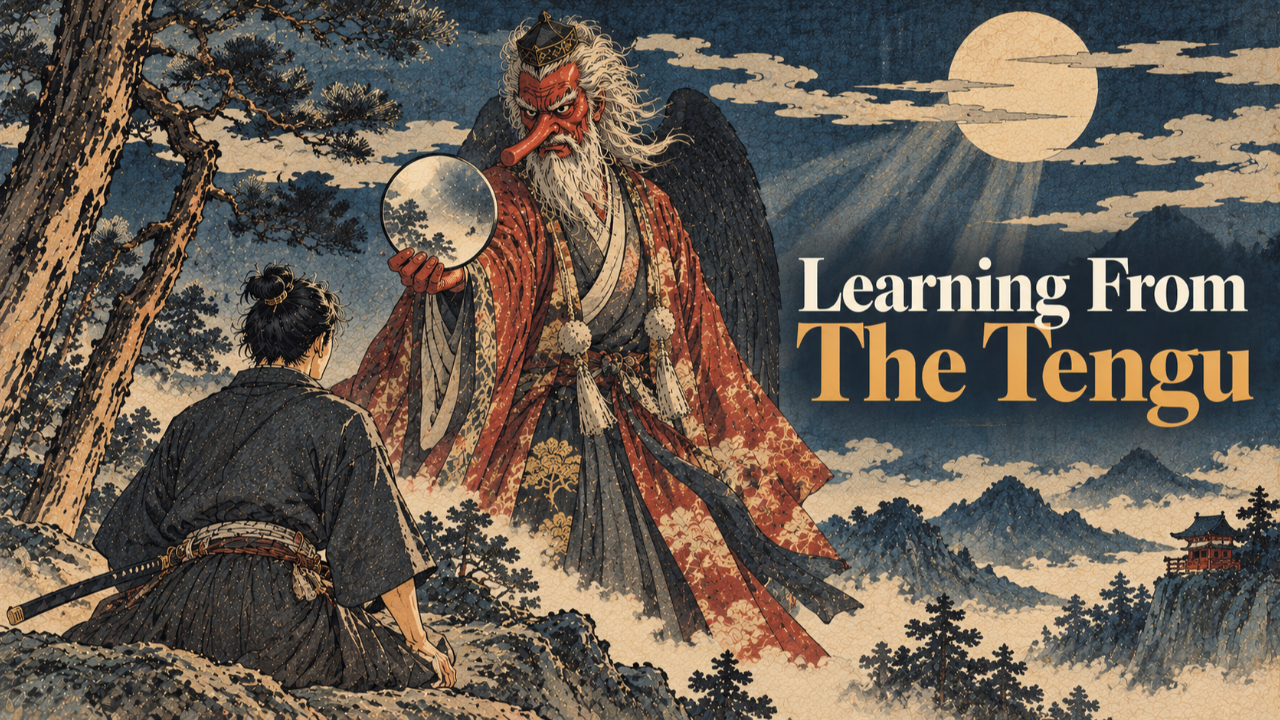
Part of any commitment to a higher Path of practice—martial arts, meditation, yoga, or any serious discipline—is the willingness to put in the time required to develop skill.
Skill matters.
It is indispensable.
But skill and mastery are not the same thing.
Skill belongs largely to the realm of what is possible through training.
Mastery asks something deeper.
Mastery asks us to confront the parts of ourselves that technical training alone cannot resolve.
In the old Japanese martial mythology, this deeper mystical Path was represented by the Tengu.
Who Were The Tengu?
The Tengu are demon figures from ancient Japanese Shinto mythology.
Often depicted as strange, supernatural beings, they were animistic and associated with mountains, forests, martial skill, and esoteric knowledge.
They were possessed of a dual nature that, depending on the conditions, could manifest as vengeful or benevolent.
The Tengu came to occupy an important place in the imagination of the warrior traditions.
In some stories, the Tengu became teachers of secret swordsmanship. But only after proving ones worthiness.
They lived beyond the ordinary world, deep in the mountains, outside the boundaries of civilized life.
To seek them out was to leave the familiar behind.
A warrior might become highly skilled through years of disciplined practice in the dojo.
But for the rare practitioner who sought something beyond technical proficiency, another journey remained.
An inward journey.
A journey into the unknown.
The journey of the spiritual warrior.
Skill Versus Mastery
To become skillful at something, we need discipline.
We need:
-
a proven method
-
technique
-
repetition
-
appropriate guidance
-
application
-
correction
-
time
Years of practice can produce extraordinary skill.
But mastery demands more.
It requires us to go beyond the limits of the ego.
Beyond the fears, desires, and identity structures that keep us confined to the person we already know ourselves to be.
This is why mastery is not simply “more skill.”
It is a different developmental demand.
Aikido founder Morihei Ueshiba left his students the injunction:
Masakatsu Agatsu — “True victory is victory over oneself.”
That phrase points directly toward the inner dimension of the warrior path.
The fundamental enemy is not ultimately “out there.”
It is within our own psyche.
The fear we refuse to face.
The desire we cannot release.
The identity we defend.
The insecurity we hide.
The patterns that keep organizing our lives even after we have become technically competent.
Mastery asks us to encounter these directly.
The Path Of The Spiritual Warrior
The path of skillfulness is common.
The path of mastery is rare.
Not because mastery is reserved for a special class of people.
Because very few are willing to keep going when the practice turns inward.
Technical training can be difficult.
But at least the problem appears manageable.
You practice more.
Improve your timing.
Refine your movement.
Strengthen the body.
Study the method.
Inner work is less predictable.
The territory itself is you.
This is where the myth of the Tengu becomes so useful.
The Tengu do not simply teach better technique.
They confront the practitioner with the one thing no amount of outer skill can avoid: themselves.
The Test Of The Tengu’s Mirror
In the mythic image I explore here, simply finding the Tengu is not enough.
The practitioner must first prove the seriousness of their intention.
The Tengu do not appear easily.
They wait until the seeker has gone beyond familiar territory.
Beyond certainty.
Beyond comfort.
Beyond their ordinary resources.
Then, when the practitioner is most vulnerable, the Karasu Tengu—the crow-like Tengu minions—descend and surround them.
There is no escape.
Then the Dai Tengu, the king of the Tengu, descends from the treetops and lands before the practitioner.
The Dai Tengu reaches into his kimono and produces a magical mirror, holding it in front of the practitioner's face.
But this is no ordinary mirror.
The Tengu’s Mirror reflects the totality of your wisdom, and the totality of your karma.
It reflects your stability of mind and spiritual strength.
But also your hidden attachments.
Your insecurity.
Your fear.
Your desires,
Your pride.
Your shadow.
Your own inner demons.
There is nowhere else to look.
What Do You Do With What You See?
This is the real test.
Not whether fear arises.
Fear will arise.
The question is whether you could remain present with a stability of mind when the entirety of your karma was reflected to you.
If you recoil—
If you collapse into denial—
If you become defensive—
If you refuse what the mirror shows—
Then your shadows control your mind.
But if you can hold your gaze,
If you can remain vulnerable,
If you can stay present without contracting away from what you see,
Then the Tengu would transform from being wrathful to altruistic.
They would kneel down before the worthy practitioner, and become teachers.
What threatened to destroy you becomes part of the Path.
That is the deeper meaning of the mirror.
Shadow As Teacher
Choosing to learn from the Tengu means accepting the challenge of facing your own inner demons.
This is a double-edged sword.
One edge cuts toward mastery.
The other cuts toward ego.
The same process that can liberate us can also inflate us.
The practitioner who begins confronting shadow can easily construct a new identity:
“I am doing deep work.”
“I am advanced.”
“I am a spiritual warrior.”
Even shadow work can become another possession of the ego.
So the Path requires courage and humility at the same time.
Courage to look.
Humility to admit that what we see is ours.
Do Not Enter Halfheartedly
There is an uncompromising quality to the Tengu myth.
If you choose to meet the shadow, you cannot do it casually.
Half-hearted inner work easily becomes performance.
We name the wound without actually feeling it.
We speak about ego without letting anything real be threatened.
We adopt the language of transformation while protecting the very structure that needs to change.
The Tengu demand more than that.
They ask for full participation.
The mirror only becomes useful when we stop bargaining with what it reflects.
Courage And Vulnerability
The warrior path is often associated with strength.
But genuine inner work requires something equally important:
vulnerability.
Courage without vulnerability becomes armor.
Vulnerability without courage can become collapse.
Together they allow us to remain present with what the mirror reveals.
This combination is essential to mastery.
The deeper the practitioner goes, the less useful the pose of invulnerability becomes.
A mature practitioner does not need to pretend there is no fear.
They become more capable of meeting fear without being controlled by it.
Mastery As “Clear Liquid”
The mythic journey does not end in the mountains.
For the practitioner who has learned from the Tengu, there is still one final movement:
return to the marketplace.
Mastery has to come back into the world.
Issai Chozanshi, the Zen sword writer who gained his wisdom from the Tengu, used a beautiful image for this.
He described the true master as someone who can take the dregs of the ancients and extract clear liquid.
I love this image.
Tradition gives us the raw material.
Forms.
Stories.
Methods.
Lineages.
Practices.
But mature mastery is not merely the repetition of what came before.
The practitioner has to penetrate deeply enough into the tradition to extract what is alive within it.
Then that living essence can be expressed again in a form appropriate to the present.
Preserving And Creating
A master may preserve an existing tradition.
Or innovate.
They may teach through established forms.
Or create something new.
The outer form is not the ultimate measure.
What matters is whether the teaching emerges from a deeper core of clarity, compassion, and wisdom.
This is one of the reasons mastery cannot be reduced to originality.
Novelty is easy.
Mastery is not.
The point is not to be different.
The point is to become transparent enough that the living principle can express itself through you.
The Tengu Within
The Tengu do not need to remain mythological creatures living in distant Japanese mountains.
The image points toward something very immediate.
Every serious Path eventually brings us to a mirror.
The question is:
What happens when your practice finally shows you what you do not want to see?
Can you remain vulnerable without losing stability of mind?
Can you courageously be with the truth?
Can you allow the very thing you fear to become a teacher?
This is where mastery stops being about technical excellence.
And becomes a Path of transformation.
